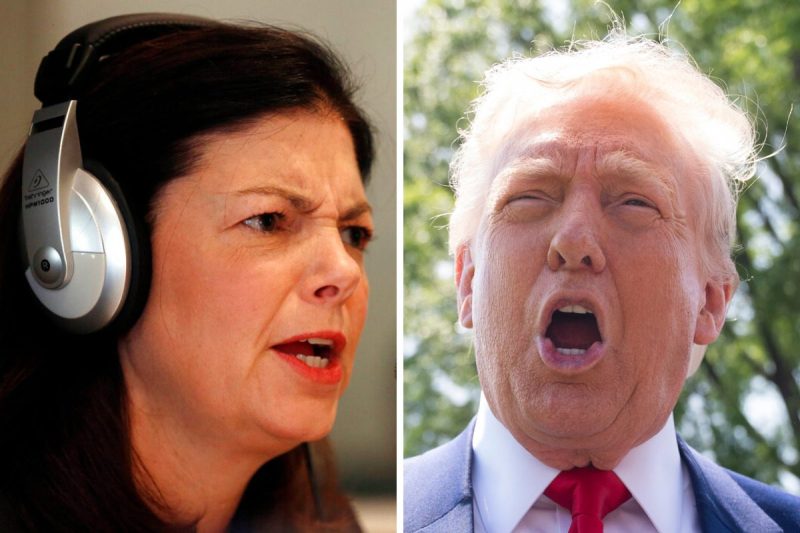
Republican President Donald Trump and Republican Governor of New Hampshire Kelly Ayotte marked their first 100 days in office this week and last, respectively — 100 days defined by economic turmoil, public backlash, and political mismanagement affecting Granite Staters at every level.
Trump’s sweeping tariffs on Canadian imports have sent shockwaves through New Hampshire’s economy, devastating local businesses ranging from timber and construction to bakeries and liquor distributors. With small businesses already describing themselves as “collateral damage,” Trump’s dismissive message — that “only the weak will fail” — has only amplified fear and uncertainty statewide.
Meanwhile, Governor Kelly Ayotte, who has remained conspicuously silent as Trump’s economic policies endanger much of New Hampshire’s economy, has experienced a similarly rocky first 100 days in office. Her term has thus far been marred by costly financial missteps, including an $80 million deficit resulting directly from her refusal to join a multistate lawsuit challenging federal cuts to public health funding by the Trump administration.
Compounding this financial mismanagement, state business tax revenues have plummeted over $129 million below projections, and Ayotte’s proposed budget was gutted by $643 million in additional cuts proposed by House Republicans—inevitably leading to reductions in essential services and higher property taxes for Granite Staters.
Ayotte has also failed to fulfill her campaign promise to address the state’s severe housing crisis, as average home prices have risen sharply to a median of $510,000, driven higher by steep increases in construction material costs directly linked to Trump’s tariffs.
Let’s look at what else each of them has or has not accomplished for the Granite State in these first 100 days:
Donald Trump
Trump’s 25% tariffs on Canadian imports have had a cascading effect on New Hampshire’s economy, raising energy costs, construction, manufacturing, agriculture, and household costs.
New Hampshire small businesses in particular have become “collateral damage” in Trump’s trade wars.
Whether it’s the timber industry, furniture stores, local hotels, bakeries, or liquor distributors, more and more local press coverage has centered around fears businesses around the state are sharing about the widespread economic impact of Trump tariffs, and the uncertainty consumers are feeling as a result. Trump’s message to those businesses that “only the weak will fail” is likely not doing a lot to put small businesses in the Granite State at ease.
As a result, Trump’s tariffs are wildly unpopular, with 57% of Granite Staters saying they strongly oppose the new taxes and 60% of Independents in the Granite State saying they too disapprove of tariffs (up 10 points from March). Trump himself is also underwater in New Hampshire, where 53% of Americans disapprove of his performance as president and 55% percent of Americans disapprove of Trump’s handling of the economy, “nearing an all-time low” for the president.
That opposition isn’t just being seen in polls. Thousands of Granite Staters have protested Trump and NH Republicans. Massive crowds have rallied in towns and cities across the state nearly every weekend over the last three months to speak out against the impact the Trump agenda is having on New Hampshire, with more protests and rallies planned in the coming days and weeks.
Kelly Ayotte
One of the most notable developments of Ayotte’s first 100 days was her overseeing a new $80 million deficit in the New Hampshire state budget, caused by her refusal to join a lawsuit with other state governors seeking to protect federal funding for New Hampshire public health programs from cuts by the Trump administration. That refusal to fight for federal funds only made the state’s other budget woes more significantThrough March, state business tax revenue is more than $129 million below expectations, creating a larger hole in the state budget than originally anticipated. Meanwhile, House Republicans slashed $643 million from her proposed budget, forcing even more service cuts, which are now expected to be downshifted into property tax hikes across the state — a favored strategy of New Hampshire Republicans.
The state’s housing woes have also worsened under Ayotte’s watch, despite her campaign pledge to address New Hampshire’s housing crisis.
Instead, the problem has gotten worse. The cost of the average single-family home price has climbed $3,000 since January, and is now up 7.4% year-over-year. The median home price has risen to $510,000. Meanwhile, building materials like hot-rolled steel, crucial for construction and a key Canadian import, are up 22.6% from $750 per short ton in January to $920 in April.
The cost of food has also increased. Granite Staters, who already pay the 3rd highest grocery prices in the country, are spending an average of $7.04 more per month since Ayotte took office.
And despite the expectation that prices will continue to increase due to Trump’s tariffs, Ayotte has remained largely silent on the matter, beyond merely “hoping” tariffs would not come to pass and saying she hoped they wouldn’t hurt “our New Hampshire businesses.”
She also failed to oppose federal job cuts that put Granite Staters out of work, including critical jobs at the Portsmouth Naval Shipyard, and instead sought to clone one of the initiatives from Trump that is driving some of those job cuts.
After Trump and his top donor Elon Musk announced the creation of the so-called “Department of Government Efficiency” (DOGE) at the federal level, Ayotte started her own DOGE clone in New Hampshire, dubbed COGE — the Commission on Government Efficiency — run by disgraced former Governor Craig Benson.
After a few months of DOGE firing thousands of American workers, causing widespread havoc, and tanking Musk’s public favorability, it seems Ayotte has backed off the idea of copying DOGE. She has mentioned COGE exactly zero times on social media since January 24th.