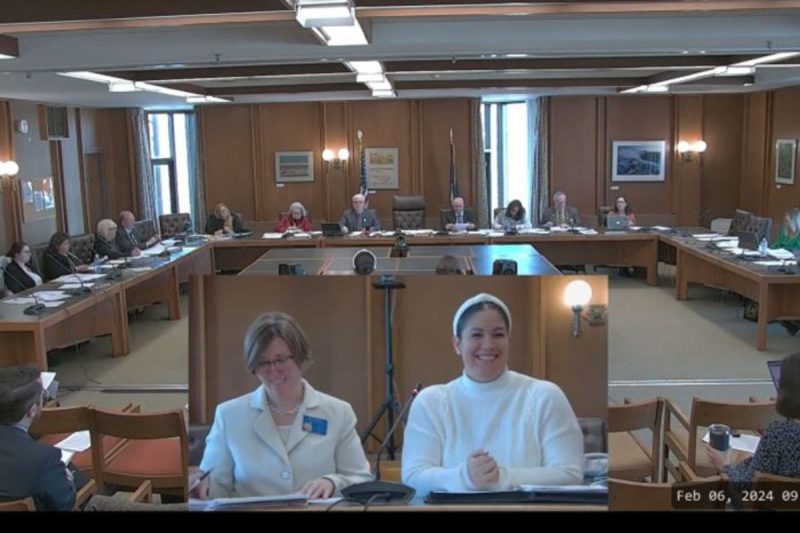
When the Office of the Child Advocate released a damning report last week alleging minors at the Sununu Youth Services Center were being subjected to punitive, jail-like conditions — including an illegal restraint that broke a child’s bone — it was the work of Child Advocate Cassandra Sanchez.
Sanchez and her team visited the facility, interviewed children and staff, viewed security footage, and demanded the facility restore full school programming.
It was exactly the kind of independent oversight the office was created to provide. And it came from the same person Gov. Kelly Ayotte tried to force out of a job.
In January, Ayotte declined to renominate Sanchez, who had served as child advocate since being appointed by Gov. Chris Sununu in 2022.
Sanchez told the New Hampshire Bulletin she was “pretty confident” the reason was her public opposition to a series of Republican bills targeting LGBTQ+ youth.
In April 2024, Sanchez joined a coalition of LGBTQ+ advocates at a press conference opposing legislation that would ban gender-affirming care for minors, ban transgender girls from playing on girls’ sports teams, prohibit transgender children from using restrooms that don’t align with their sex at birth, and require public school teachers to disclose a student’s sexuality to parents if asked. Sanchez argued that advocating for all children — including LGBTQ+ youth — was part of the office’s mandate. She said legislative advocacy made up roughly 5 percent of the office’s work.
Republicans saw it differently. By April 2025, multiple lawmakers were openly citing that advocacy as a reason to slash or eliminate the office’s budget entirely.
Sen. Victoria Sullivan (R-Manchester) who is now overseeing an investigation for the latest round of abuse at the facility, told NHPR she would support restoring funding only if the office maintained “a more narrow focus,” calling its LGBTQ+ advocacy a “distraction” from the office’s core work.
RELATED: NH GOP to probe youth detention abuse with lawmaker who threatened to defund oversight office
The Legislature ultimately passed a law prohibiting the child advocate from engaging in what it deemed as partisan advocacy — a provision Sanchez said she was “not extremely clear on” but “could assume” was a reference to her LGBTQ+ work. The budget also cut the office’s staff from nine to four, eliminating the legislative liaison position that had handled most of the advocacy. After the cuts took effect, Sanchez told the Ledger-Transcript she wouldn’t have time to follow bills closely or advocate in the Legislature even if she wanted to.
Sanchez never backed down. When asked whether she would have done anything differently, she told the Bulletin: “By no means would I ever change our stance on those issues and the way in which we advocated to support all children in the state.”
In 2025 House budget writers voted along party lines to eliminate the office altogether.
When a Democratic lawmaker asked, “Are you sure about the child advocate? They’re the overseer of YDC,” Republicans pressed ahead anyway, citing roughly $2 million in savings over two years. The office ultimately survived through budget negotiations — but the Legislature passed a law prohibiting the child advocate from engaging in what it deemed partisan advocacy.
Ayotte denied that Sanchez’s LGBTQ+ advocacy was a factor in her removal. Instead, she nominated Diana Fenton, a former assistant attorney general who had worked with Ayotte at the Department of Justice two decades earlier and was serving as legal counsel at the Department of Education.
Fenton had no experience in child welfare. Sanchez warned of “a huge learning curve” for any successor who lacked child welfare expertise. But the question of her experience quickly became irrelevant.
Fenton withdrew her nomination in March 2026 after a bruising four-hour confirmation hearing before the Executive Council. Fenton was a foster parent in an active custody case before the Division for Children, Youth and Families, and her husband, family court Judge Todd Prevett, had been sanctioned by the Judicial Conduct Committee for trying to use his judicial position to waive a records check in a guardianship case the couple was pursuing. Ayotte said she was unaware of the sanction.
Now Sanchez remains in the role only because Ayotte’s replacement fell apart, and the office she leads has been cut from nine staff to four.
This is part of a broader pattern. Since taking office, Ayotte has moved repeatedly to weaken the independence of the people and institutions responsible for holding the state accountable on child welfare.
She replaced the independent YDC settlement fund administrator — a former Supreme Court chief justice confirmed by the judiciary — with a political appointee.
Ayotte also signed a law giving Republican Attorney General John Formella veto power over how much abuse survivors get paid.
She put zero dollars into the settlement fund in her first budget.
Moira O’Neill, the first person to serve as child advocate, warned last year about what eliminating or weakening the office would mean.
“It’ll be bad. There will be bad things happening,” she said. “New Hampshire is just going to embarrass itself, aside from really harming kids.”