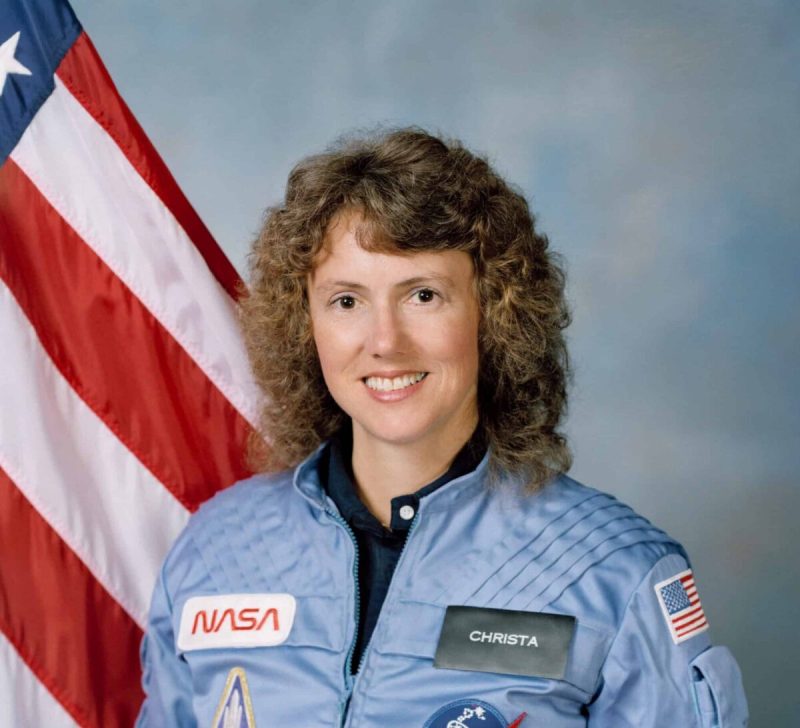
New England native Christa McAuliffe left an enduring impression following her death in 1986. Here’s how she’s been honored since.
When Christa McAuliffe died in 1986, I hadn’t been born yet. It would be six years before that happened, and another six years after I came into the world before I started to hear her name. Growing up in New England, it was impossible for teachers to discuss the vastness of the universe without speaking about McAuliffe’s remarkable, inspiring story. A persistent sadness remained for those who were alive to bear witness to the Challenger explosion, and the only way to make it more manageable was to teach others about the crew members and their accomplishments.
My mom said she just missed the launch by the time she got home on January 28, 1986, but she could still remember the sinking feeling in her gut when she learned that everyone on board the space shuttle had perished. In that moment, she closed her eyes and thought of McAuliffe, a fellow mom, as so many people did in New Hampshire and across the country. The 37-year-old school teacher had been accompanying the Challenger crew as a recently trained payload specialist, a position she was suited for. That role requires people to complete a number of tasks, including research, satellite deployment, operating specialized scientific equipment, and conducting various experiments.
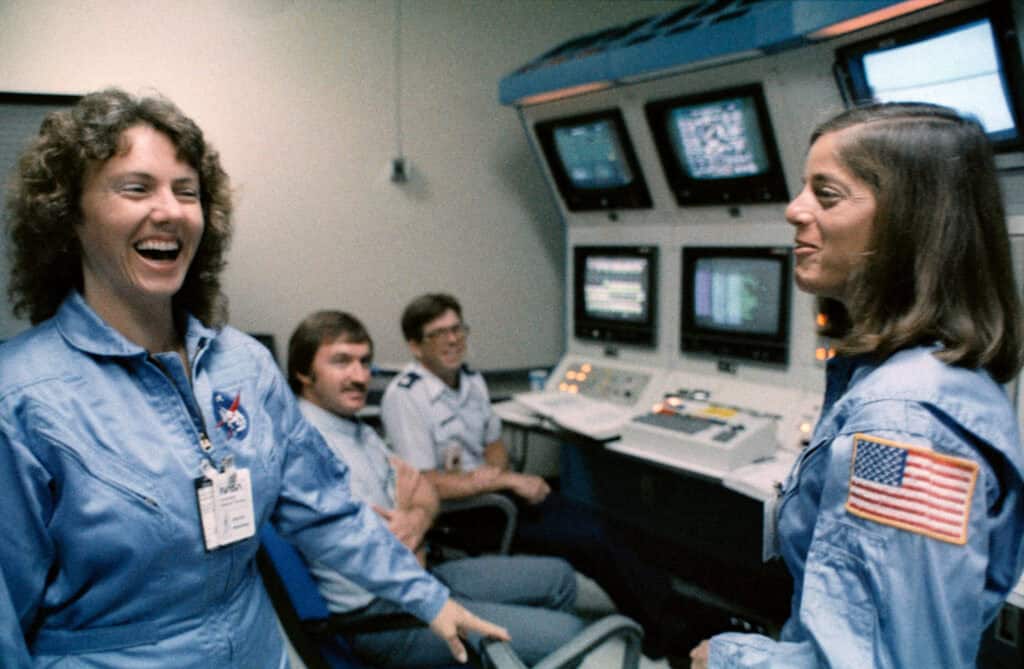
Almost every article written about McAuliffe over the last 40 years has all made mention of the fact that she was an ordinary person hand-selected to do an extraordinary thing. Which, of course, she was. But ultimately, anyone who has ever done anything extraordinary has always begun their journey from an ordinary starting point. Some may be born into more wealth and privilege than others, but they all began life in the same way you and I did—by learning shapes and colors, and transitioning from soft foods to solid ones; by having people teach them how to read and spell their name; by having to face the daunting task of making friends for the first time; by discovering whether they like sandwiches with or without the crust. We all have the potential to grow from those milestones into ones that are progressively more astounding and impactful. McAuliffe is proof of that, but she’s also proof of what hard work, dedication, determination, and kindness can do for you.
When the former director of the McAuliffe-Shepard Discovery Center in Concord, New Hampshire, Jeanne Gerulskis, was asked why she wanted to create a more permanent tribute to McAuliffe, Gerulskis’s response was simple. “I would want people to focus on how I lived and what I cared about, and the fact that I wanted young people to learn all they could about the universe we live in,” she said. The universe we live in—the one many of you previously shared with McAuliffe when she was still alive—is a largely unexplored frontier. There have been other disasters in the Challenger’s wake, and there have also been numerous achievements. Ordinary people were involved in all of these things, and they all shared McAuliffe’s mindset: Anyone is capable of doing anything as long as they’re willing to show up and put in the work.
Christa McAuliffe allowed herself to dream the biggest dream imaginable when she filled out an 11-page application and mailed it to NASA. She proved to thousands of people from Framingham, Massachusetts, to Concord, New Hampshire, to Houston, Texas, that extraordinary things await all of us if we can muster up the bravery required to reach out and grab them. McAuliffe’s personal motto was, “I touch the future, I teach.” She couldn’t possibly have known that the greatest lesson she would lead would come in the wake of her death, or that she’d be touching the future for countless generations to come, but she knew what she was doing was worthwhile. That’s all any of us can ever really hope for in the end.
McAuliffe’s involvement with NASA
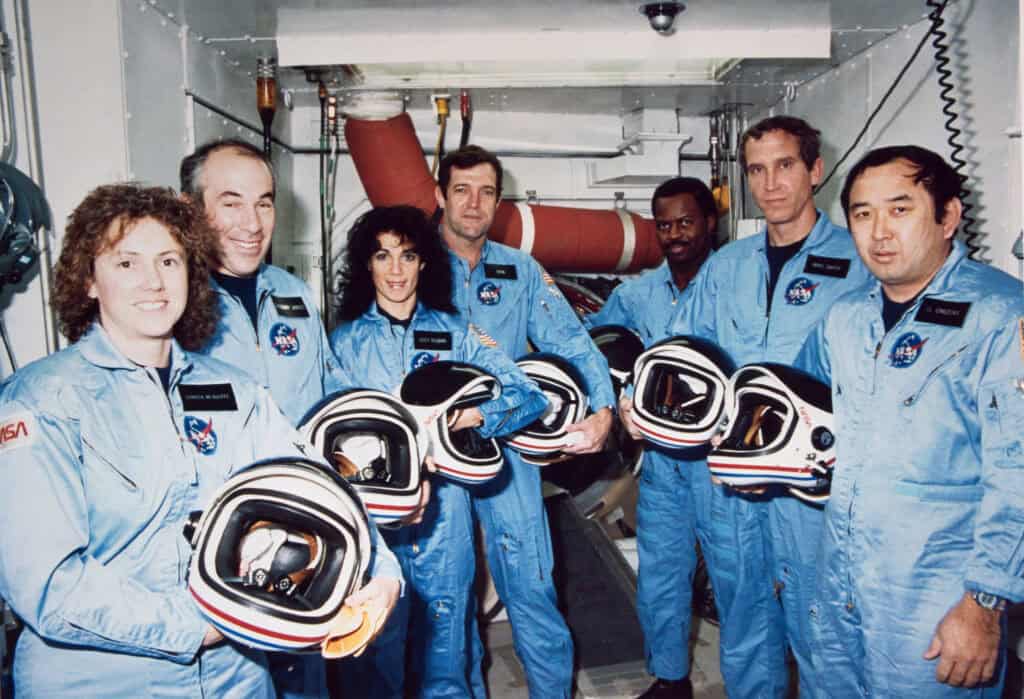
Seventy-three seconds after the Challenger space shuttle lifted off the ground in Cape Canaveral, Florida, on January 28, 1986, it exploded. All seven astronauts traveling aboard the vessel died. Their names were Gregory Jarvis, Judith A. Resnik, Francis R. (Dick) Scobee, Ronald E. McNair, Mike J. Smith, Ellison S. Onizuka, and Christa McAuliffe.
To understand the nuances of their mission and what led to the fatal explosion, I highly recommend Adam Higginbotham’s book, “Challenger: A True Story of Heroism and Disaster on the Edge of Space.” In it, Higginbotham meticulously details NASA’s history with space travel while carefully unraveling the exact sequence of events that led to the Challenger disaster. It’s an impressive journalistic feat, and one I won’t try to replicate here. Instead, I’ll be focusing on how McAuliffe became involved in the mission.
Sharon Christa McAuliffe was a Framingham, Massachusetts native. She met her future husband, Steve McAuliffe, when the two were still attending Marian High School. She graduated with a degree in history and education from Framingham State College in 1970. Christa and Steve married and had two children together, Scott and Caroline. They eventually moved to Concord, New Hampshire, after Steve attended law school and Christa earned a masters degree in school administration. She first taught at Bow Memorial School before accepting a position at Concord High School to teach economics, law, and American history. During her tenure, she created a special curriculum, “The American Woman,” as a way of examining historical events from women’s perspectives.
Everyone who had Christa as their teacher loved her. She became known as The Field Trip Teacher because she was an advocate for hands-on learning. Many of her students said she was an “inspirational human being, a marvelous teacher who made their lessons come alive.” It’s no surprise to discover, then, that Christa was interested in the idea of having a field trip of her own when the “Teacher in Space” program was announced on August 27, 1984. Speaking about the application and review process, Christa said, “I cannot join the space program and restart my life as an astronaut, but this opportunity to connect my abilities as an educator with my interests in history and space is a unique opportunity to fulfill my early fantasies. I watched the space program being born and would like to participate.”
Steve and Christa’s family and friends were supportive of her desire to apply. Out of 11,500 applications, hers was selected along with several other finalists. She was ultimately chosen as the best candidate and headed to Houston in September 1985 to begin her training. Christa hoped, as did those operating the “Teacher in Space” program, that her presence would reignite interest in NASA and its space missions after support dwindled in the preceding years. “A lot of people thought it was over when we reached the Moon. They put space on the back burner. But people have a connection with teachers. Now that a teacher has been selected, they are starting to watch the launches again,” Christa said. She was right. More and more people began to show interest in what McAuliffe and her fellow crew members were doing.
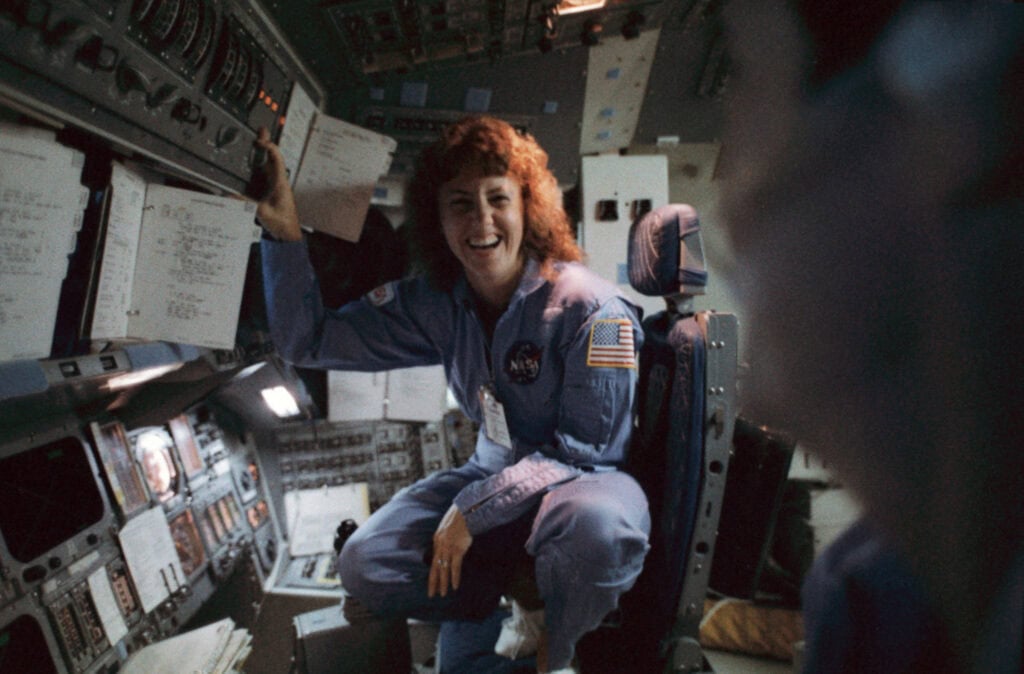
It was a monumental period for those witnessing Christa work alongside Judith Resnik. In an essay for Literary Hub, writer Joyce Maynard—who knew Christa personally after interviewing her for a piece—said, “In the years when Christa and I grew up, women didn’t get to be astronauts. They married or gave birth to them.” Seeing two women make history added another layer of excitement to the Challenger’s mission. During this time, Christa completed over 114 hours of extensive training to prepare her for her role as one of the crew’s payload specialists. There were plans to have her lead two lessons while the shuttle was in space to teach people about the astronauts, how their roles worked, and what life was like for them while they were orbiting the Earth. Christa was also planning to keep a diary to use for future lessons. It was something she relied on for her “American Woman” curriculum, as diaries helped students better understand the firsthand experiences of these women.
“You have to dream. We all have to dream. Dreaming is okay. Imagine me teaching from space, all over the world, touching so many people’s lives. That’s a teacher’s dream! I have a vision of the world as a global village, a world without boundaries. Imagine a history teacher making history!” Christa said. Tragically, these things didn’t come to fruition as she originally imagined. With the deaths of the Challenger’s crew came enormous, unending grief. Amid the tide of that, one tribute appeared after another to the loving, patient, adventurous school teacher and mother who cared so deeply about the pursuit of education.
Countless tributes have been made following her death
After Christa McAuliffe died, schools, libraries, and discovery space centers cropped up across the country bearing her name, including:
- Christa McAuliffe Center, Framingham State University – Framingham, MA
- Christa McAuliffe Charter School – Framingham, MA
- McAuliffe Branch Library – Framingham, MA
- Christa McAuliffe Middle School – Los Alamitos CA; Boynton Beach FL; Jackson NJ; Houston TX
- McAuliffe International School and McAuliffe Manual Middle School – Denver, CO
- McAuliffe-Shepard Discovery Center – Concord, NH
- Christa McAuliffe Space Center – Pleasant Grove, UT
- Christa McAuliffe Elementary School – Tinley Park, IL
There is also the aforementioned McAuliffe-Shepard Discovery Center in Concord, New Hampshire, dedicated to McAuliffe and fellow astronaut Alan Shepard, who hailed from Derry, New Hampshire. Thousands of students learn about space there each year in a continuation of McAuliffe’s final dream of touching people’s lives around the world. For Enfield, New Hampshire, resident Nancy, McAuliffe was an inspiration, despite the two not knowing each other. “The fact that they were sending up a teacher who was prepared to enlarge the minds of not only students in schools, but everyone else—I just thought it was a fabulous thing,” Nancy said. She added that, “To have her not be able to do that is a real loss in my opinion. We have a planetarium here in New Hampshire named after her, and she’s still teaching even if she’s not here.”
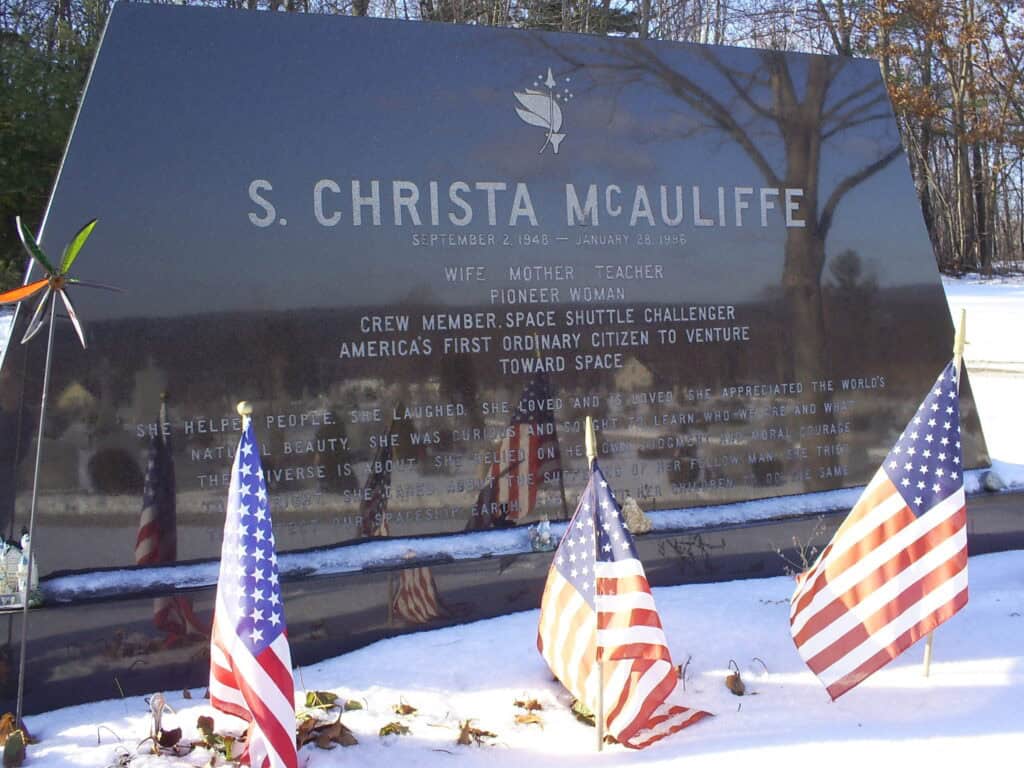
The lessons McAuliffe has instilled in others are as boundless as the edges of space itself. Laurie MacKenzie Gordon, who began teaching at Concord High School a year after the Challenger disaster, said she used McAuliffe’s curriculum, “The American Woman,” with her own students. Gordon spoke with NPR about her fellow teacher in 2026 for the 40th anniversary of McAuliffe’s death. “She was a feminist—empowering women and girls—absolutely part of her mission. And she did that through the study of history—primary documents primarily—diaries, journals,” Gordon said. It’s yet another example of how important McAuliffe’s approach and mindset were in shaping how others gained new knowledge.
In a perfect world, Christa McAuliffe, Judith Resnik, Gregory Jarvis, Dick Scobee, Ronald McNair, Mike Smith, and Ellison Onizuka would have lived to see the myriad ways in which their work inspired others. We unfortunately do not live in that perfect world, but we do live in one where the people who love us are committed to keeping our memories alive. Those who knew McAuliffe personally and those who admired her from afar do this every single time they point to the night sky and name a constellation. My mother did not have the good fortune of knowing her, and of course, neither did I, but we cherish her as if we did. For a brief time as a child, I, like many young girls growing up in New Hampshire and Massachusetts, wanted to be an astronaut. That dream gave way to another, and another, until I eventually found one that suited me best, but my interest in learning more about space has remained. I have Christa McAuliffe to thank for that. And hopefully after reading this, you do too.
This article first appeared on Good Info News Wire and is republished here under a Creative Commons license.
Related: Why some NH schools are restricting use of phones inside classrooms